- Teacher: Admin User
keerthini.gnomio.com
-
Welcome to your new Gnomio site
Now, you are in control!
Moodle is an open-source Learning Management System (LMS) that provides educators with the tools and features to create and manage online courses. It allows educators to organize course materials, create quizzes and assignments, host discussion forums, and track student progress. Moodle is highly flexible and can be customized to meet the specific needs of different institutions and learning environments.
Moodle supports both synchronous and asynchronous learning environments, enabling educators to host live webinars, video conferences, and chat sessions, as well as providing a variety of tools that support self-paced learning, including videos, interactive quizzes, and discussion forums. The platform also integrates with other tools and systems, such as Google Apps and plagiarism detection software, to provide a seamless learning experience.
Moodle is widely used in educational institutions, including universities, K-12 schools, and corporate training programs. It is well-suited to online and blended learning environments and distance education programs. Additionally, Moodle's accessibility features make it a popular choice for learners with disabilities, ensuring that courses are inclusive and accessible to all learners.
The Moodle community is an active group of users, developers, and educators who contribute to the platform's development and improvement. The community provides support, resources, and documentation for users, as well as a forum for sharing ideas and best practices. Moodle releases regular updates and improvements, ensuring that the platform remains up-to-date with the latest technologies and best practices.
Links of interest:
(You can edit or remove this text)
Available courses
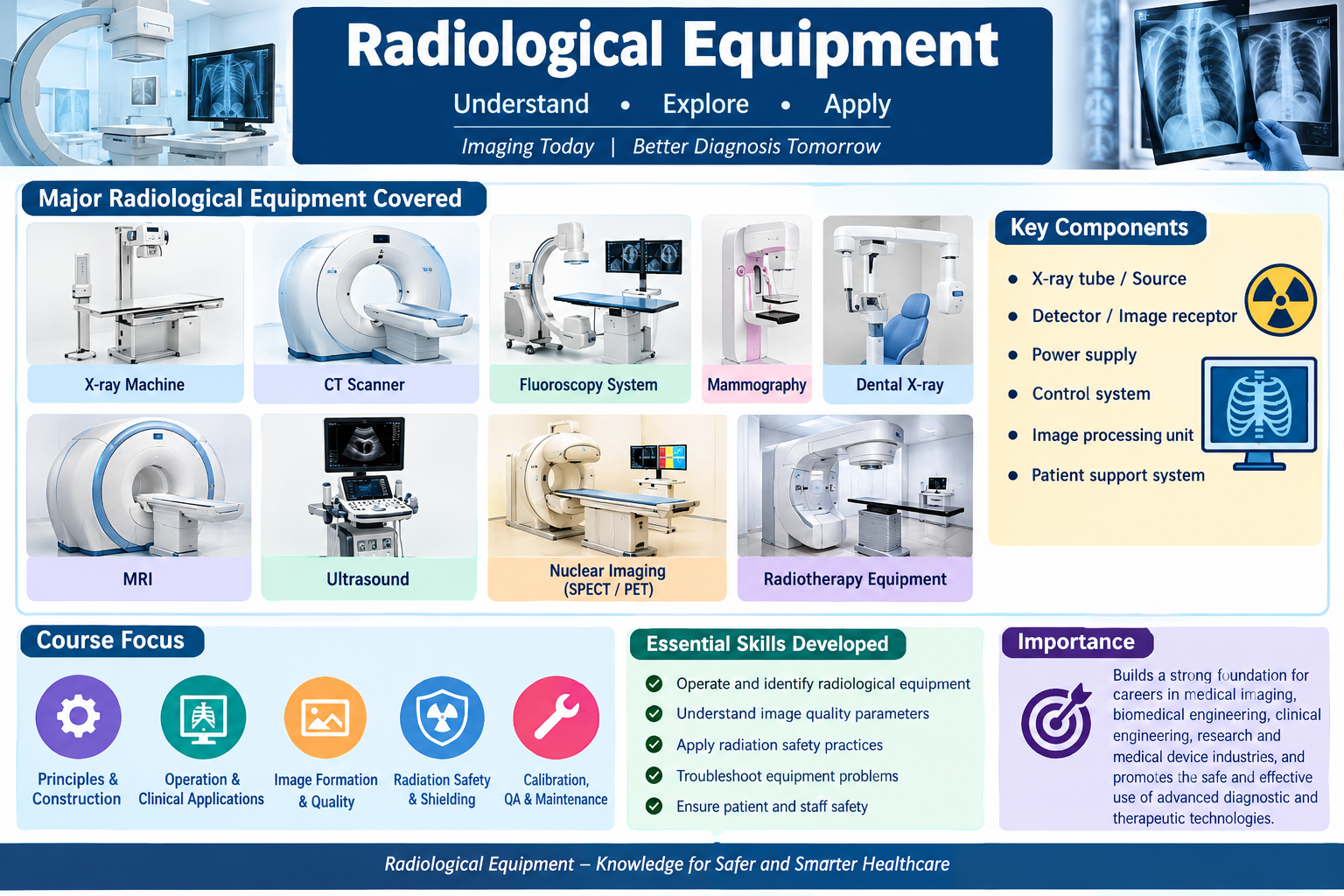
Importance of the Radiological Equipment Course
The Radiological Equipment course is important for developing a fundamental understanding of the principles, construction, operation, and clinical applications of various imaging and radiation-based medical equipment used for diagnosis and treatment. The course familiarizes students with X-ray machines, CT scanners, fluoroscopy systems, mammography, dental X-ray, MRI, ultrasound, nuclear imaging systems, and radiotherapy equipment, along with their major components and working principles. It helps students understand image formation, image quality, radiation safety, shielding, dosimetry, equipment calibration, quality assurance, and preventive maintenance. The course also develops the ability to identify equipment-related problems and understand safety requirements for patients, healthcare professionals, and the general public. Knowledge of radiological equipment provides a strong foundation for careers and further studies in biomedical engineering, medical equipment service, clinical engineering, medical imaging, healthcare technology, research, and medical device industries, while promoting the safe and effective use of advanced diagnostic and therapeutic technologies.
- Teacher: Admin User
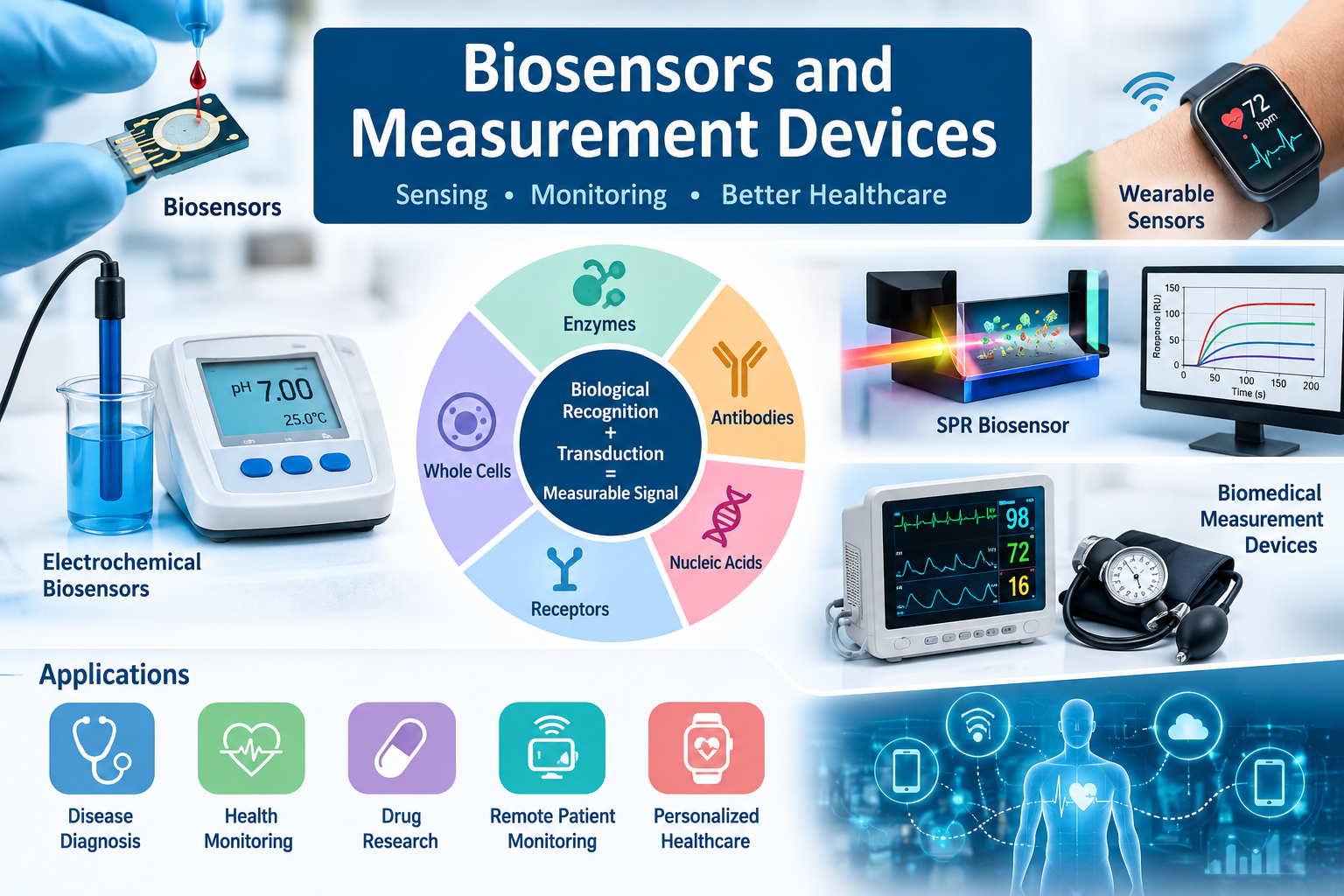
Course Objective – Biosensors and Measurement Devices
The course aims to provide students with a comprehensive understanding of the principles, classification, construction, working, and applications of biosensors and biomedical measurement devices used for the detection and monitoring of biological and physiological parameters. It focuses on various biorecognition elements such as enzymes, antibodies, antigens, nucleic acids, and receptors, along with different transduction techniques including electrochemical, optical, piezoelectric, thermal, and semiconductor-based methods. The course enables students to understand potentiometric, amperometric, conductometric, ISFET, IMFET, glucose, pH, blood gas, optical, and SPR biosensors, as well as measurement devices for temperature, pressure, blood pressure, blood flow, heart rate, and oxygen saturation. It also introduces emerging technologies such as wearable and implantable biosensors, continuous glucose monitoring, lab-on-a-chip, microfluidics, point-of-care diagnostics, IoT-enabled sensing, and remote patient monitoring, while developing the ability to evaluate sensor performance based on sensitivity, selectivity, accuracy, precision, response time, stability, linearity, and detection limit.
- Teacher: Admin User